THE REVERSE-FUNNEL STRATEGY
TIRE AMERICA: A CRO-FOCUSED
REVERSE-FUNNEL REDESIGN.
I implemented a Reverse-Funnel CRO Audit to resolve High-Impact Revenue Leaks. By prioritizing Checkout-Up Optimization, I delivered a high-conversion UI/UX blueprint to transform a legacy agency build into a Performance-Driven Logic Engine.
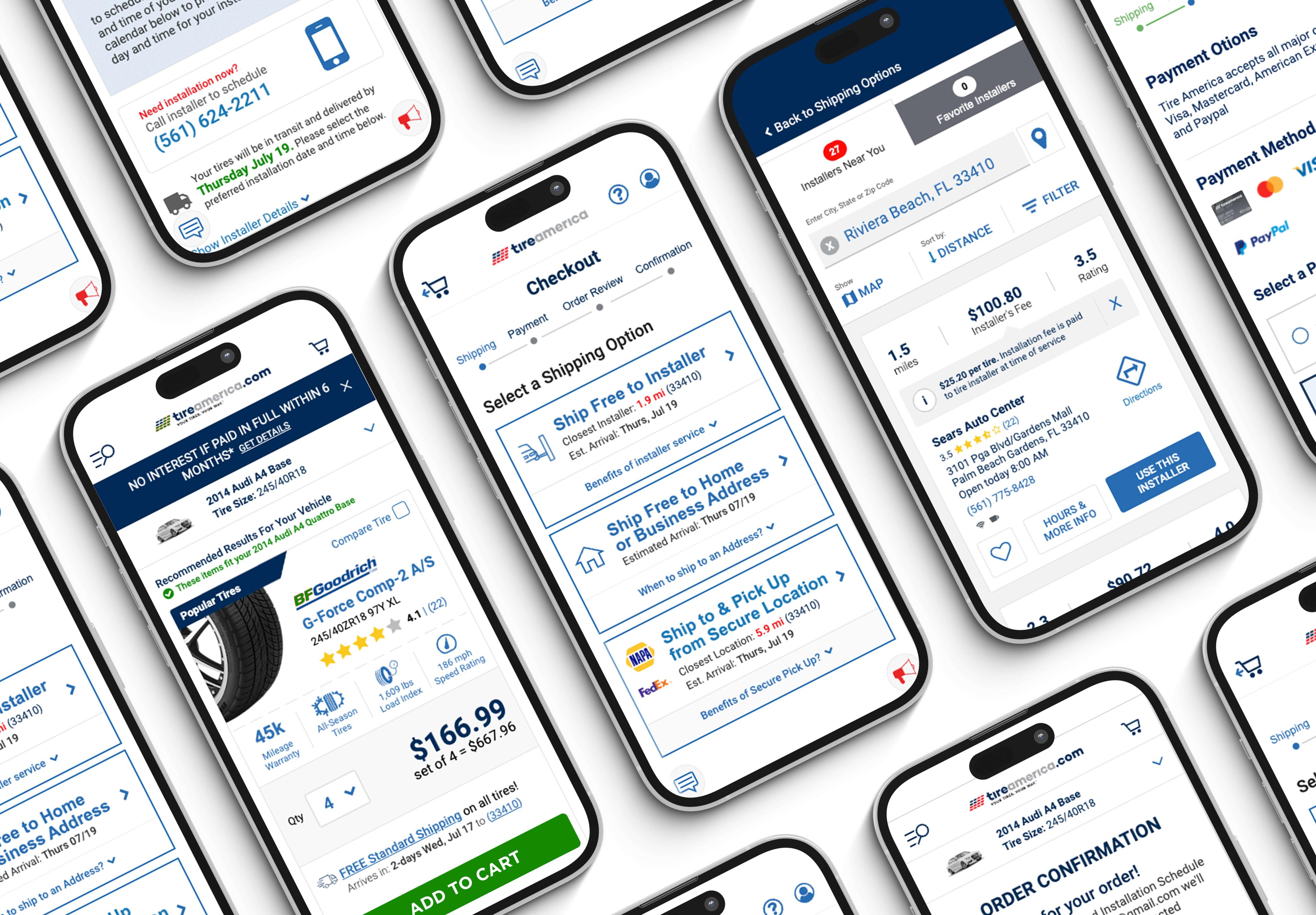
Watch: A walkthrough of a high-fidelity checkout funnel.
Role
Lead Principal Designer
Focus
Reverse-Funnel CRO Redesign
Objective
+46.5% Usability Benchmark
Context
eCommerce Agency Takeover
Timeline
2018–2019
Strategy & Leadership
"Functioning as the Lead UI/UX Architect for the $100M+ Tire America ecosystem, I managed a team of four designers to navigate the complex salvage of an underperforming agency build. I provided Strategic Governance over complex Fulfillment Logic—leveraging 15 years of pattern recognition to pre-architect a Scalable CRO Engine."
Leveraging 15 years of pattern recognition to pre-architect scalable solutions.
Daily Alliances
Ownership:Lead UI/UX: Tire America eCommerce Ecosystem | Multi-Designer Team Management | Stakeholder & Agency Governance
THE OBJECTIVE
BENCHMARKING B2C FRICTION.
THE FRICTION
An agency-built tire purchase flow suffered from high drop-off rates. Product cards buried key specs, shipping defaults caused accidental selections, and the calendar UI on mobile was effectively invisible for transit windows beyond 3 days.
View Details
THE LEVER
Session replays and business feedback revealed two critical friction layers: PLP decision fatigue (too much noise, not enough scannability) and silent checkout defaults that routed users into the wrong fulfillment path without their knowledge.
View Details
THE OUTCOME
Delivered streamlined PLP → Checkout wireframes after identifying key optimization targets. Redesigned product cards for scannability, replaced dropdown shipping selectors with explicit fulfillment cards, and drove a 46.5% desktop usability score — nearly double the competitor average.
View Details
Discovery Baseline: Competitive Benchmarking
Establishing the friction threshold across 5 industry competitors prior to the hi-fi salvage operation.
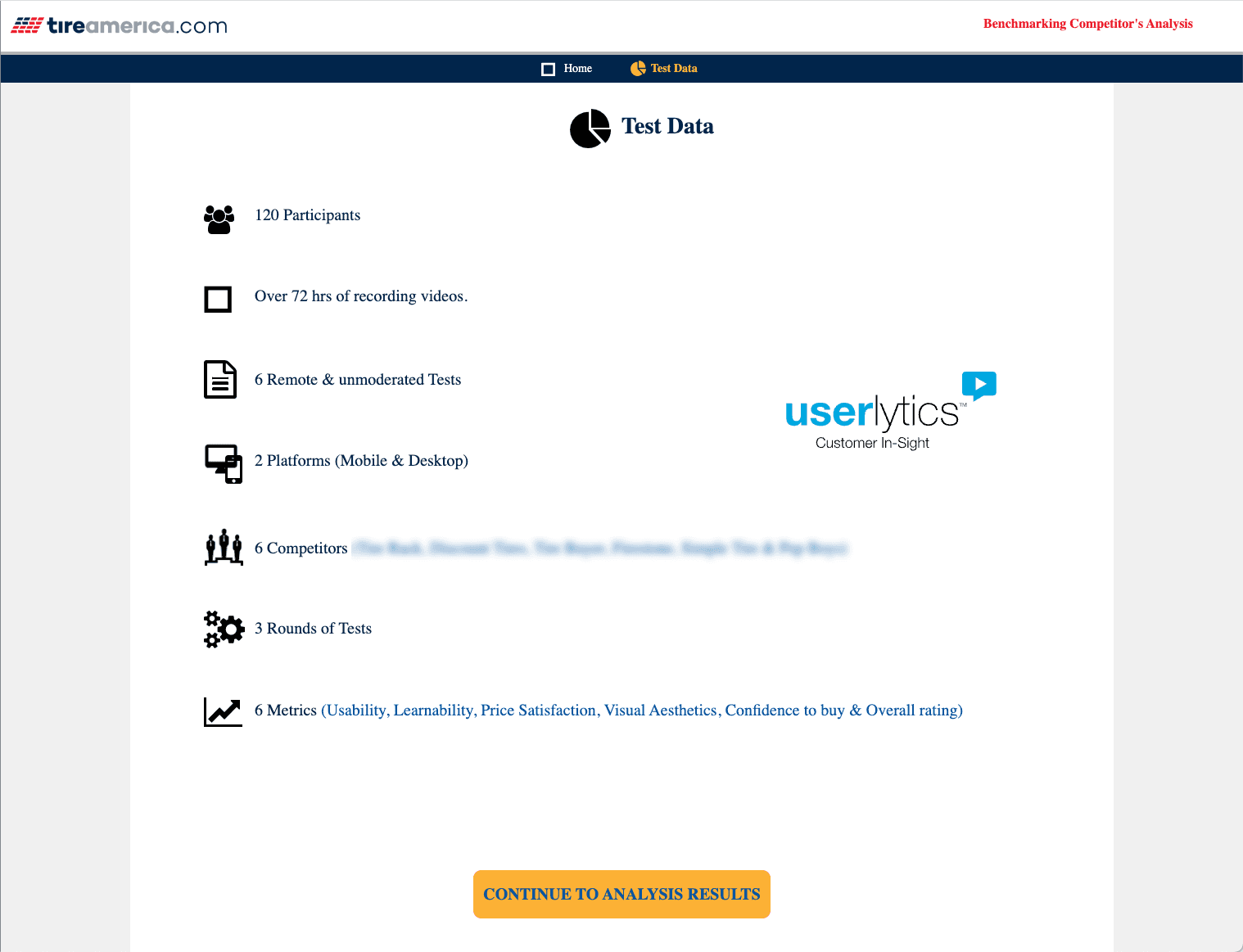
Competitive benchmarking study — participant demographics and test structure
Benchmarking study overview showing participant demographics, recruitment criteria, and test structure across 120 remote unmoderated sessions.
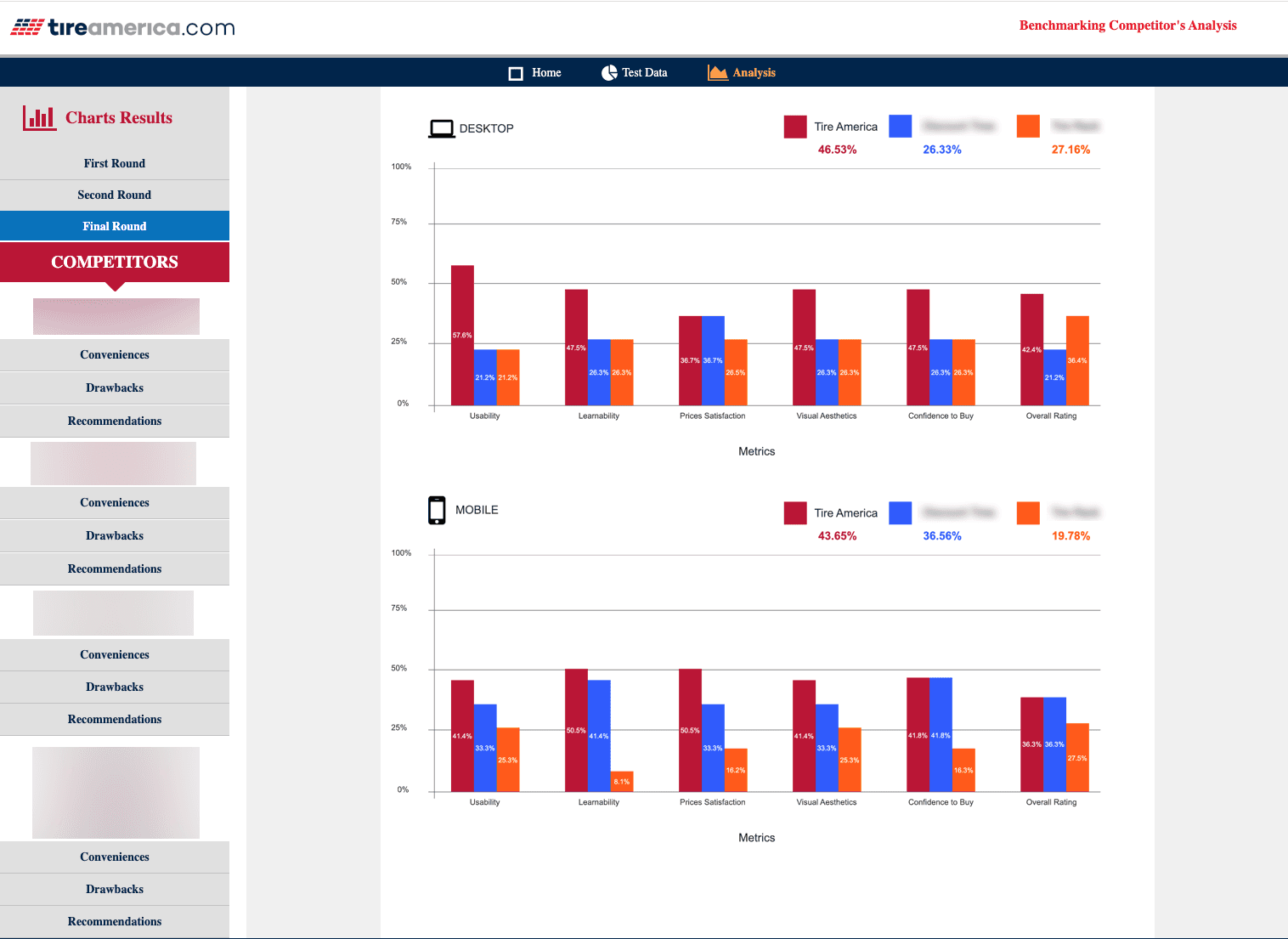
Competitive benchmarking — usability and learnability scores comparison
Usability and learnability score comparison across Tire America and 5 industry competitors. Tire America's desktop score of 46.5% nearly doubles the competitor average.
Phase 1 · Product Discovery
PLP Clarity + Confidence.
Product cards were the first decision gate for tire shoppers. The legacy design buried critical information — specs, fitment signals, pricing clarity, and shipping ETAs were either missing or competing for attention, causing decision paralysis.
Problem
A routine ticket to surface "FREE Shipping ETA" on PLPs exposed a larger conversion bottleneck. The existing legacy PLP cards failed to show critical decision info, acting as a barricade rather than a gateway.
Evidence
Session reviews and heuristic tests revealed aggressive backtracking. Users were forced to "pogo-stick" into detail pages to verify basic specs like weight/speed, while the primary CTA competed confusingly with a frustrating quantity selector default.
Solution
Redesigned the PLP hierarchy, trading vertical height for absolute clarity. Surfaced real-time specs (weight/speed), established dominant affordance for total pricing, and decoupled the core CTA from the quantity stepper.
Outcome
By eliminating structural ambiguity early in the discovery funnel, we successfully anchored fulfillment expectations before users ever hit the checkout—drastically reducing the friction of detail-page pogo-sticking and protecting intent.
Step 1: The YMME Gateway.
In automotive e-commerce, the funnel doesn't start until the vehicle is defined. The Year/Make/Model/Engine (YMME) widget is the absolute gateway to discovery. This exploration shows how we reverse-engineered the original agency homepage (left)—stripping away visual friction to prioritize systemic validation (right) that gets users into the catalog faster.
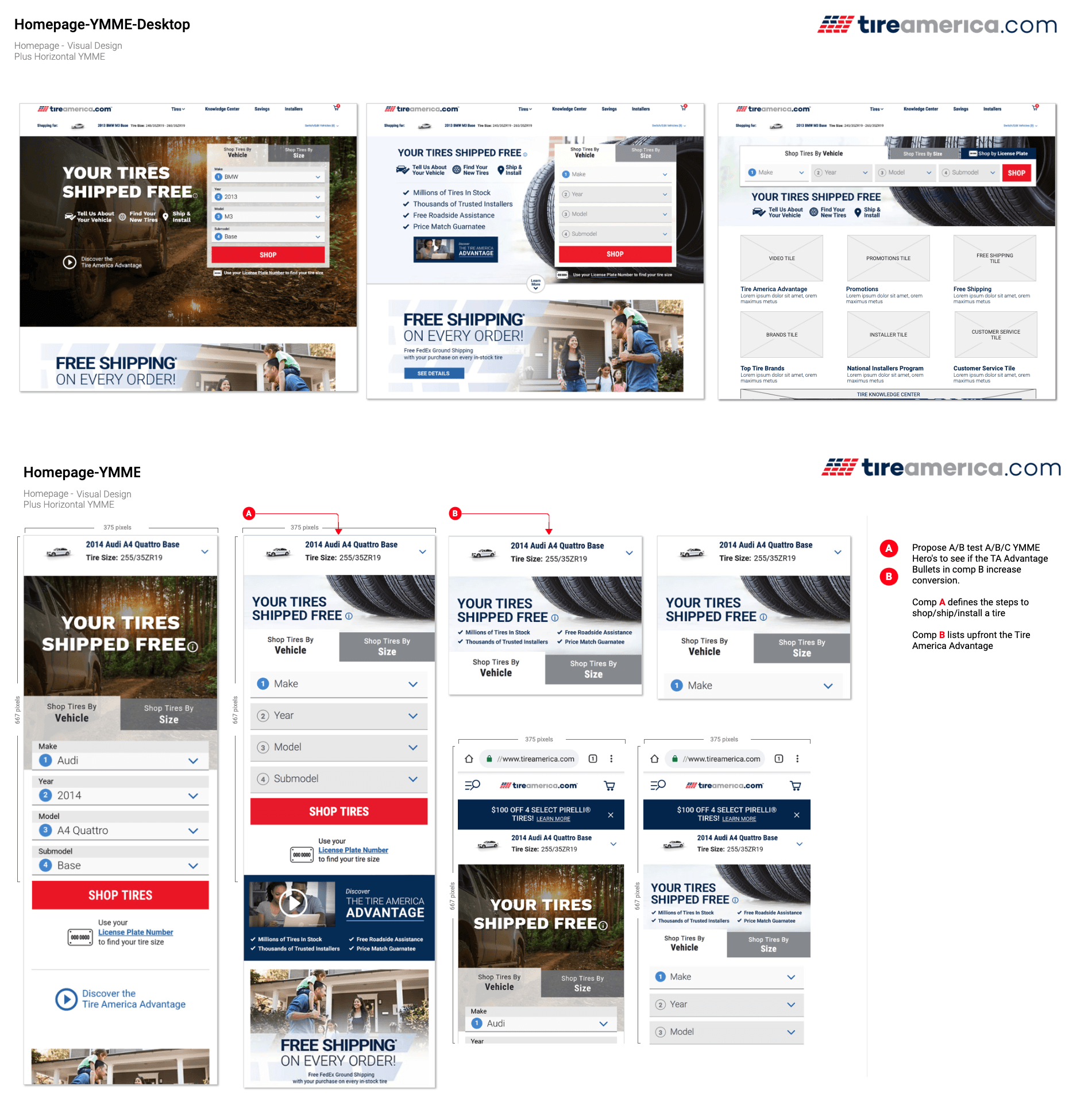
Top-of-funnel YMME (Year, Make, Model, Engine) vehicle taxonomy selector
Homepage YMME widget exploration. Architecting the global entry point for automotive e-commerce to ensure users hit the PLP with 100% fitment confidence.
Step 2: PLP Information Architecture.
Once fitment is validated, the PLP assumes control. Here, we traded vertical height for clarity, eliminating decision paralysis.
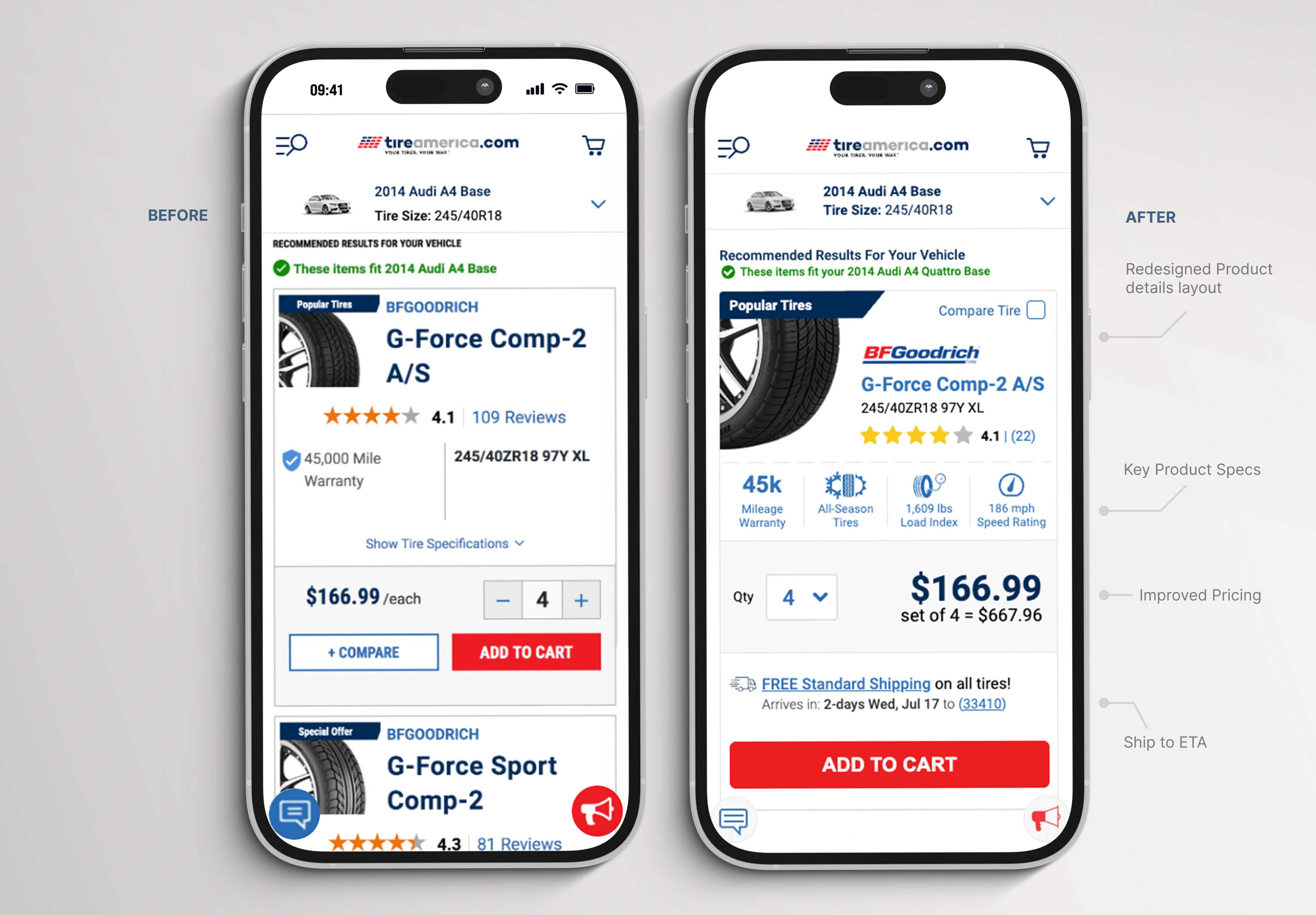
PLP Card Redesign — Before and After comparison showing improved specs, pricing, and shipping ETA
Side-by-side comparison of the PLP product card. The redesign surfaces tire specs, fitment badges, competitive pricing, and shipping ETA at a glance — enabling confident add-to-cart without leaving the listing page.
Architectural Logic: PLP Confidence & Fitment
- ■YMME Gateway Optimization: Reduced visual noise to accelerate vehicle definition and catalog entry.
- ■Product Card IA: Redesigned hierarchy trading vertical height for absolute clarity on specs, fitment, and shipping ETA.
- ■Backtracking Mitigation: Reduced "pogo-sticking" by anchoring fulfillment expectations early in the discovery funnel.
Phase 2 · Checkout Optimization
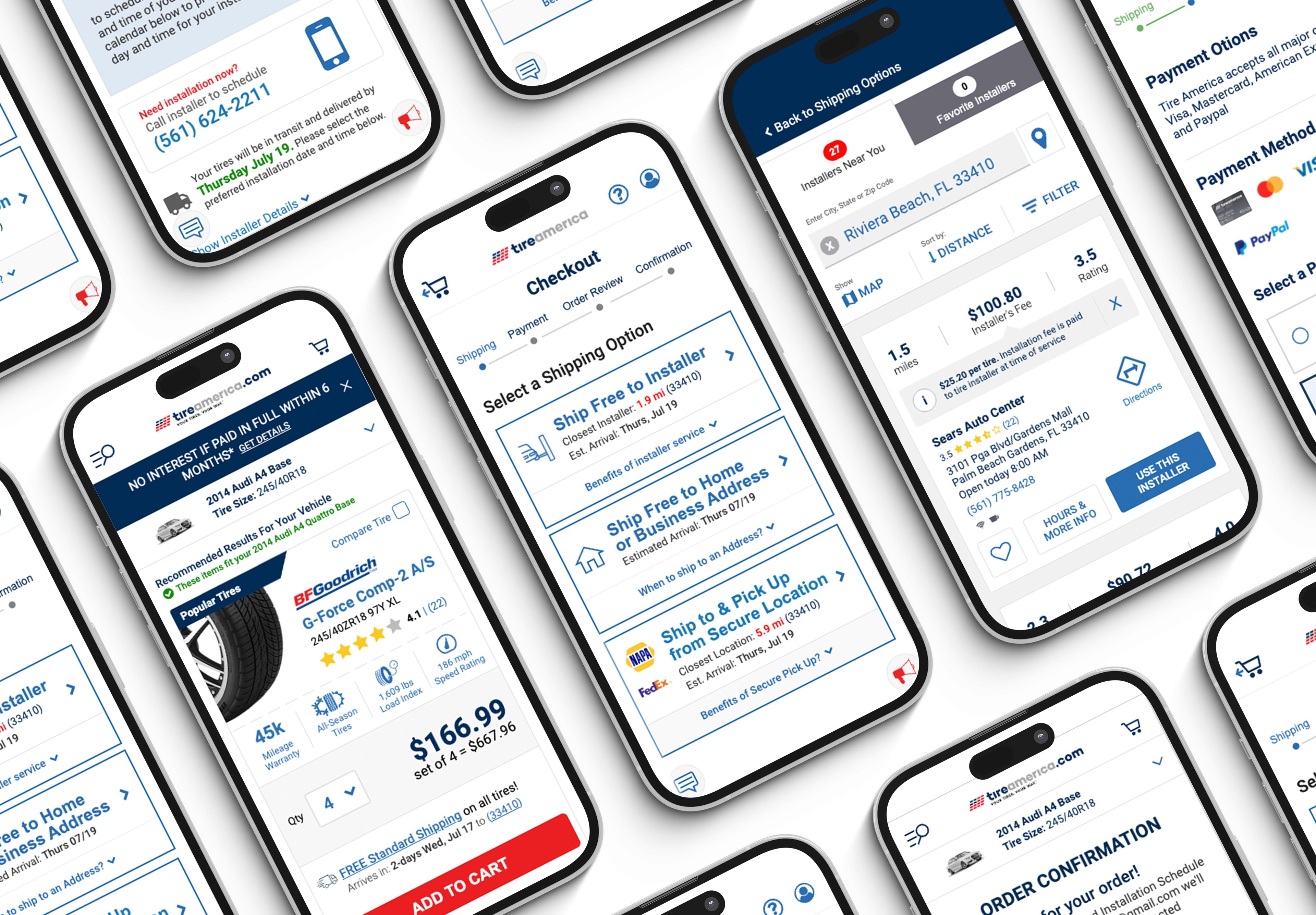
Shipping & Fulfillment Selection Re-architecture.
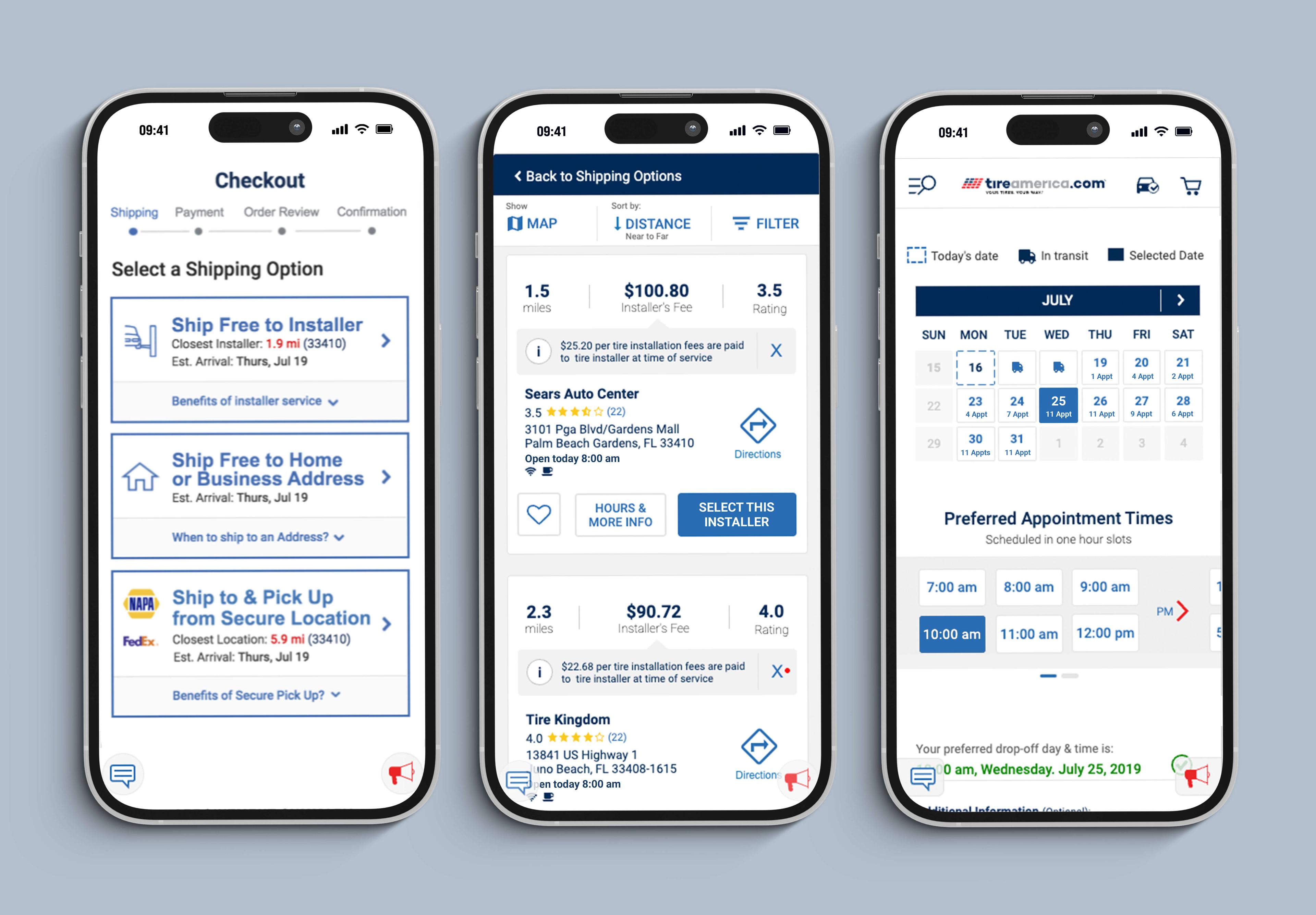
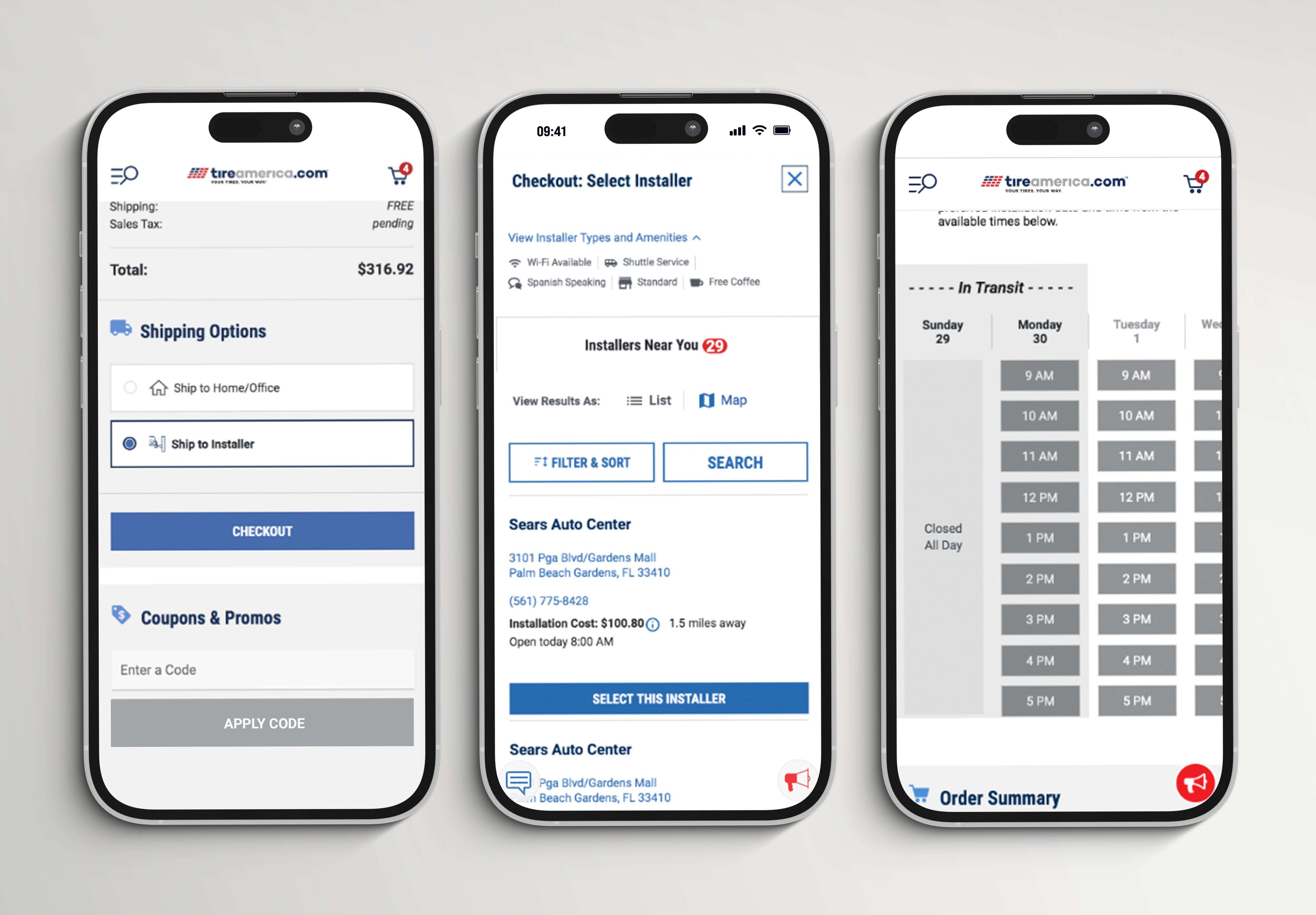
Two critical checkout decisions were invisible to users: fulfillment method and installer/delivery date selection. Customers silently defaulted into the wrong shipping path and the swipe-based calendar caused missing available dates — both driving backtracking and drop-off.
Problem
Silent defaults routed users into "Ship to Home" without intent. The swipe-based calendar hid available dates when transit exceeded 3 days, making date selection feel broken on mobile.
Solution
Removed the silent default — required explicit fulfillment selection. Replaced dropdowns with visual fulfillment cards (installer partners, Ship-to, Pick-up). Swapped the swipe calendar for a traditional full-view calendar.
Outcome
Eliminated accidental fulfillment selections and calendar confusion. By forcing intentional selection earlier in the flow, we drastically reduced downstream cart abandonment and backtracking.
Before
After
Loading Artifacts
Design Artifacts
Wireframe captures and desktop explorations that document how the core patterns evolved from concept to MVP-ready layouts.
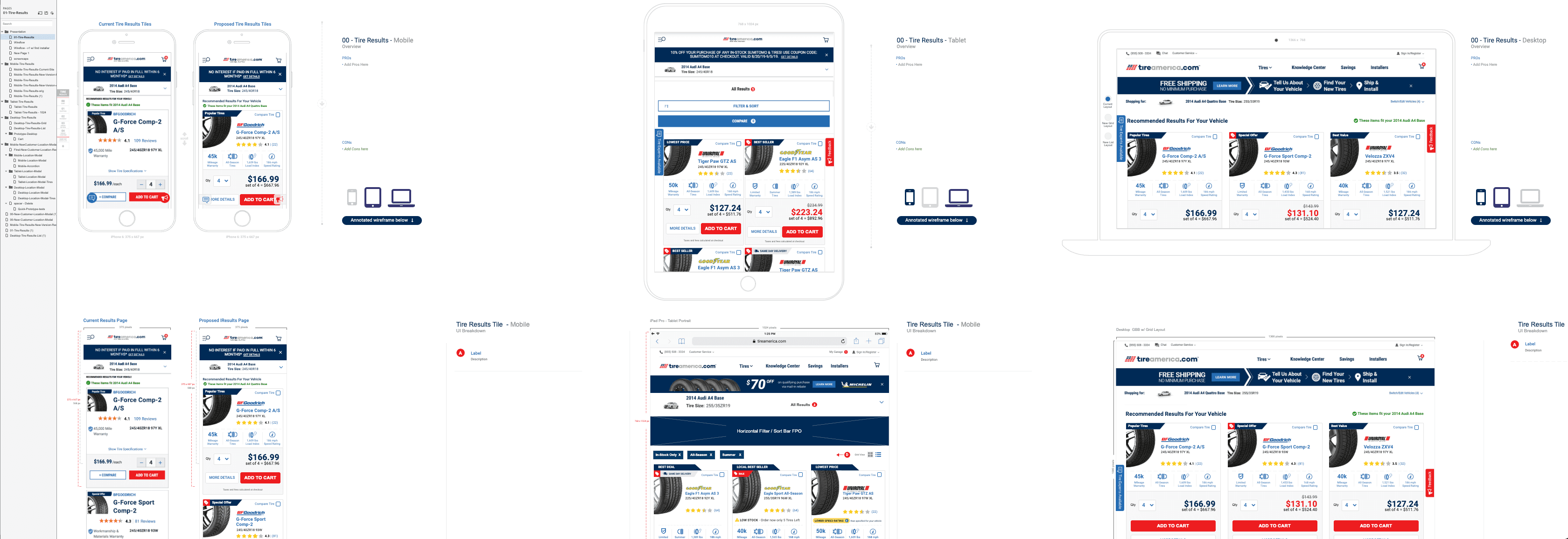
Screen capture of Axure Prototype + Wireframes
Screen capture from my Axure checkout redesign file. It includes an anchored left nav and mobile/tablet/desktop prototypes across the top (icon tabs to switch between views). Each breakpoint has an annotated wireframe with developer notes and UI specs.
This was before Axure’s Inspect feature in Axure Cloud, which now generates a lightweight spec view (redlines, CSS, typography, measurements, assets) so engineers can build with less back-and-forth.
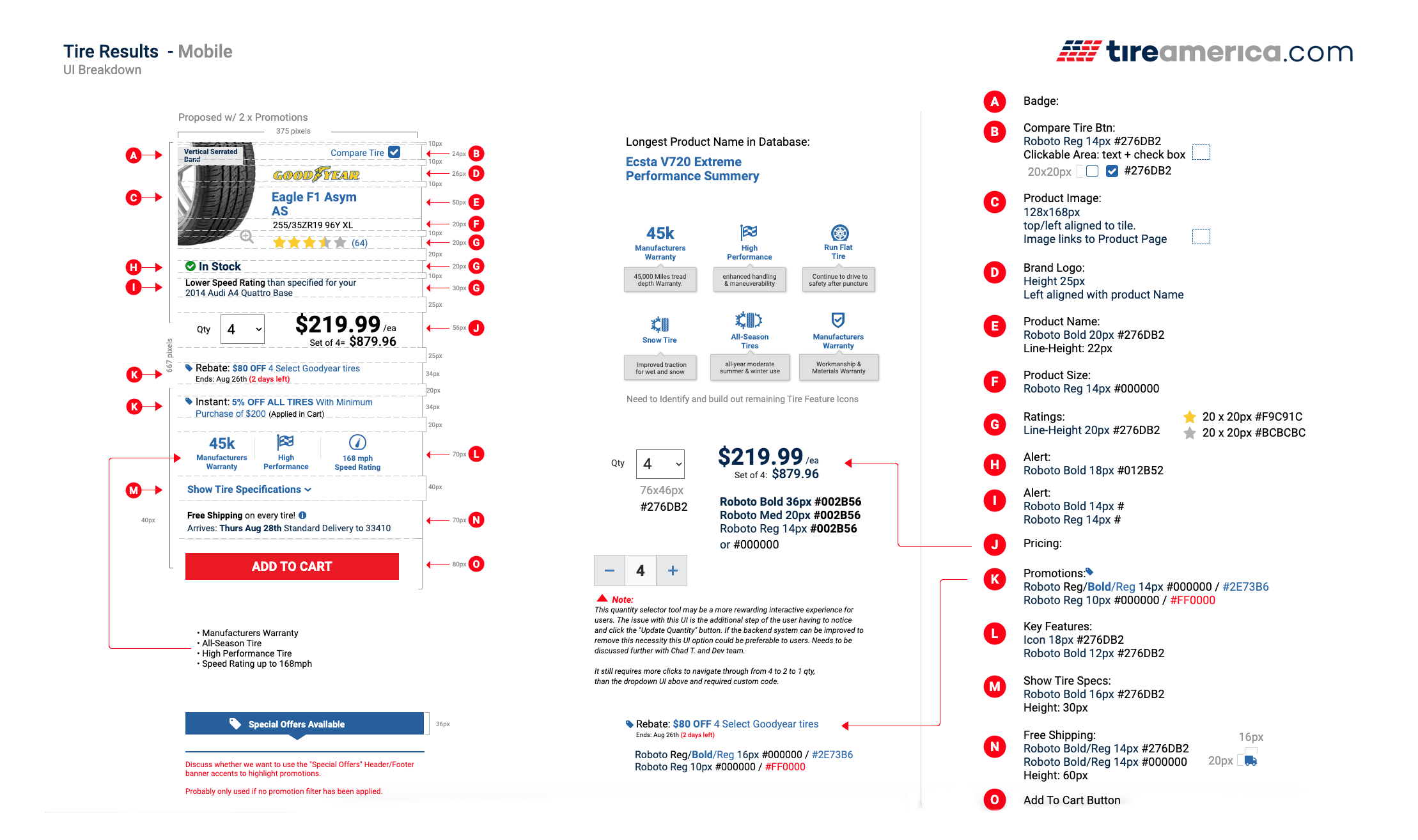
Annotated wireframes for dev handover with UI specs
Detailed wireframe annotations documenting spacing, typography, conditional logic, and component states — reducing design-to-dev ambiguity during implementation.
Annotated Wireframes
Axure – annotated wireframes for dev handover (pre-Inspect era).
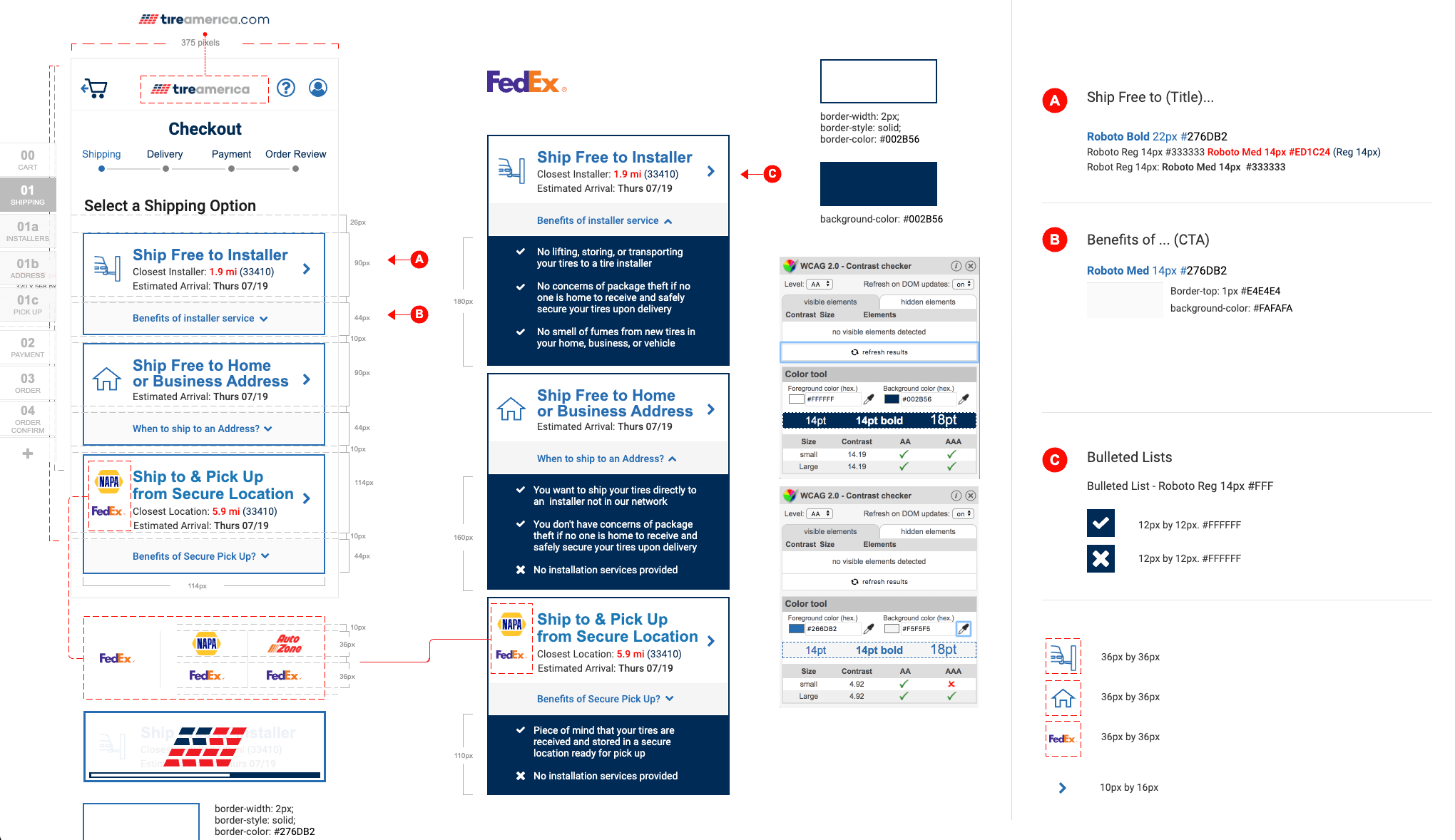
Shipping Options with WCAG Contrast Proofing
Strict WCAG AAA and AA contrast testing embedded directly into the wireframing spec to ensure accessible typography and interactions.
Accessibility (a11y) Contrast Proofing
Evaluating Typography and Color combinations against WCAG 2.0 AAA/AA contrast benchmarks during the wireframing phase to guarantee ADA compliance for visual impairments.
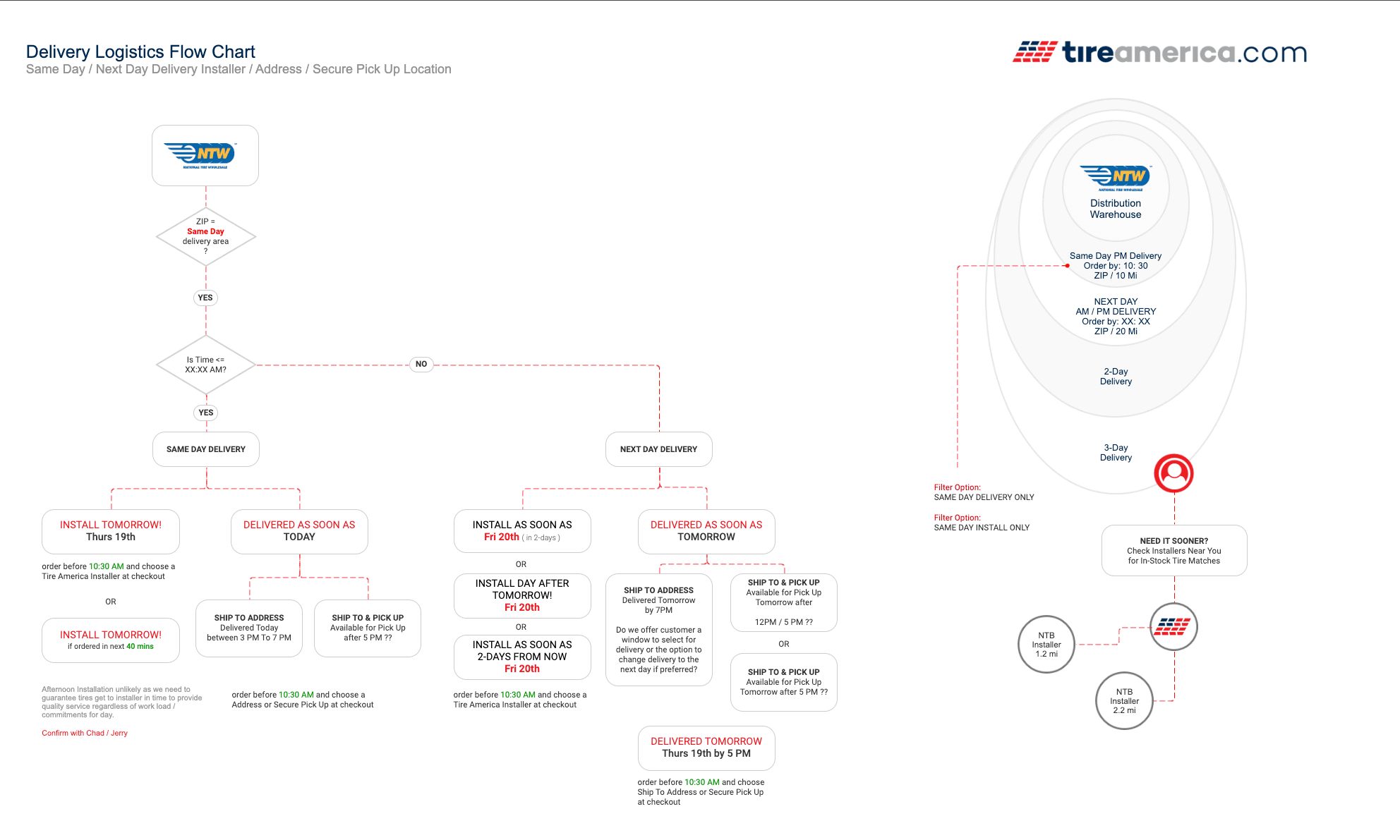
Delivery Logistics Flowchart
Systems thinking approach mapping the backend fulfillment logic, state-machine transitions, and transit constraints. This map was critical for identifying and mitigating 'silent defaults' prior to wireframing.
Delivery & Logistics Mapping
Systems flowchart defining the complex routing constraints for delivery and installation fulfillment, mapped out before touching any UI.
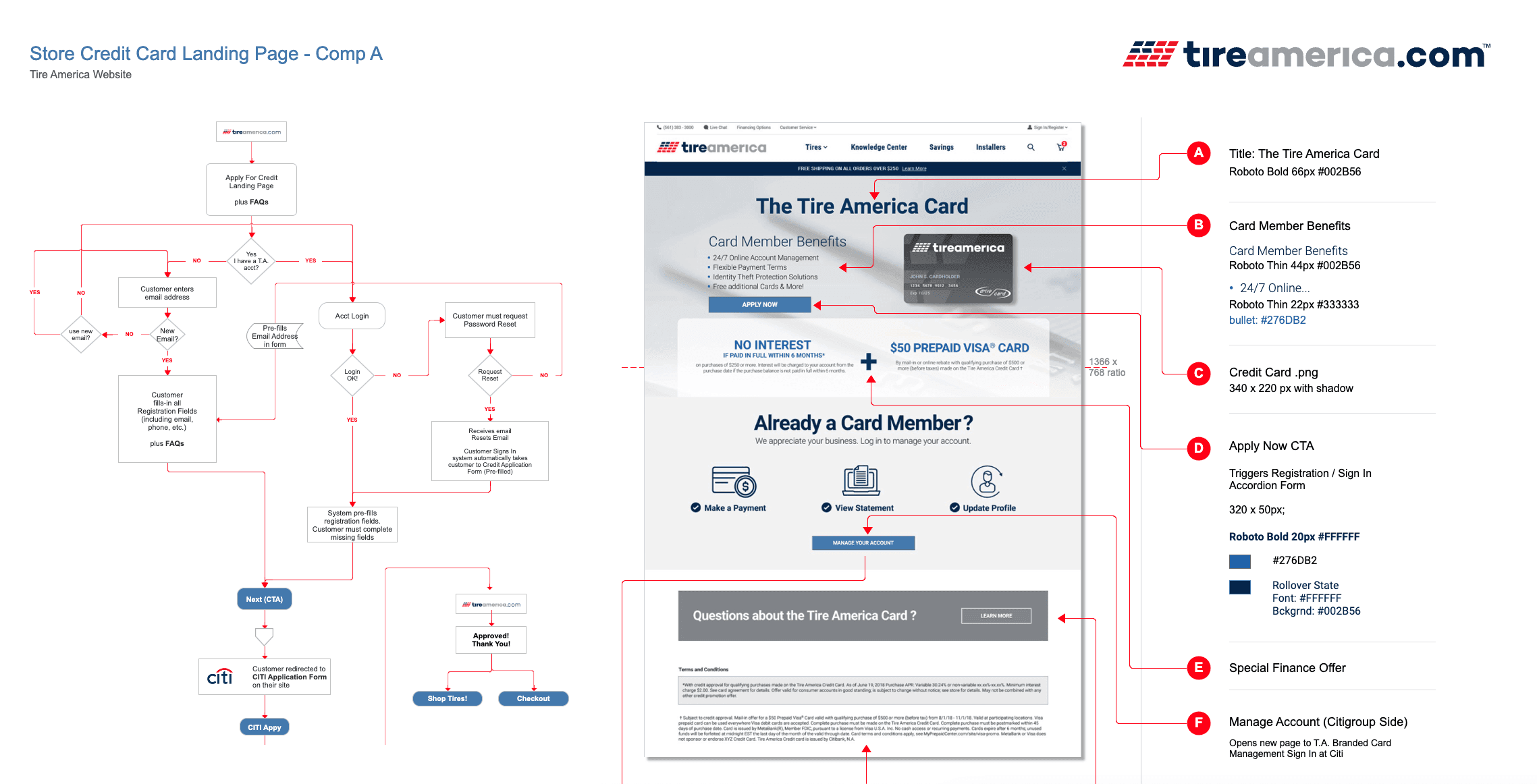
Store Credit Application Journey (Flowchart)
Store credit application flow mapped out to highlight conditional states and API routing.
Store Credit Application Journey (Flowchart)
Store Credit Application Journey (Flowchart)
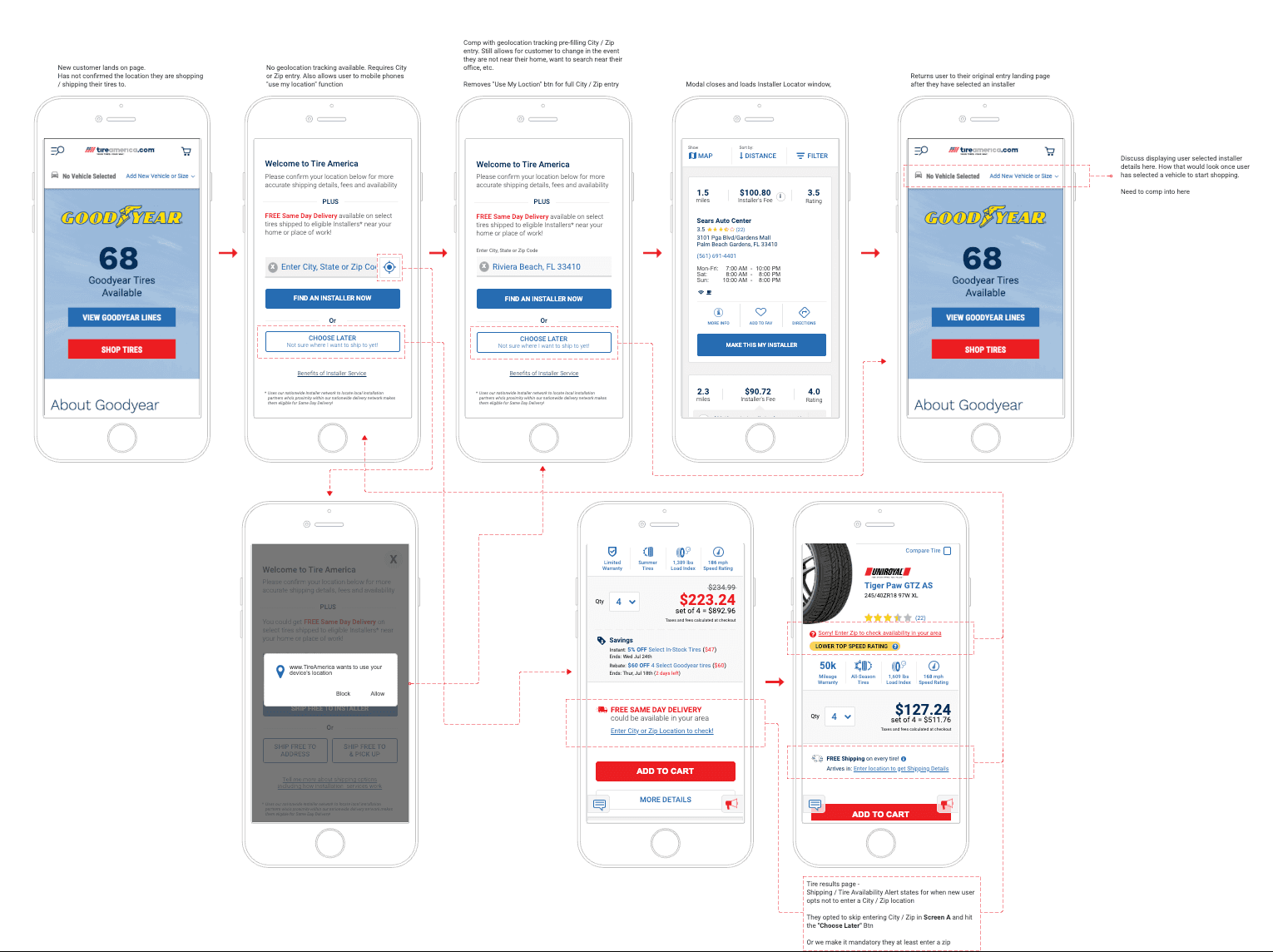
Low IP / Not Hi-Res
Set Location to Installer Selection wireflow
End-to-end wireflow mapping the user journey from location input through installer selection. Documents decision points, error states, and branching logic for fulfillment routing.
Architectural Logic: Checkout Optimization & Logistics
- ■Explicit Fulfillment (TA-2019): Removed silent defaults in favor of high-affordance selection cards for installers and shipping.
- ■Calendar Re-architecture: Replaced swipe-based mobile calendar with a full-view grid to surface dates beyond the 3-day transit window.
- ■Axure Interaction Specs: Delivered dev-ready annotated prototypes with conditional logic and responsive breakpoint specifications.
- ■Delivery Logistics Mapping: Systems-level flowcharting of backend fulfillment constraints prior to UI development.
Pragmatic Validation
Targeted Risk
Mitigation.
As an agency takeover, the mandate was velocity. Standard lo-fi cycles were bypassed to prioritize systemic validation via hi-fi comps immediately, all vetted heavily by cross-functional teams and business stakeholders prior to implementation.
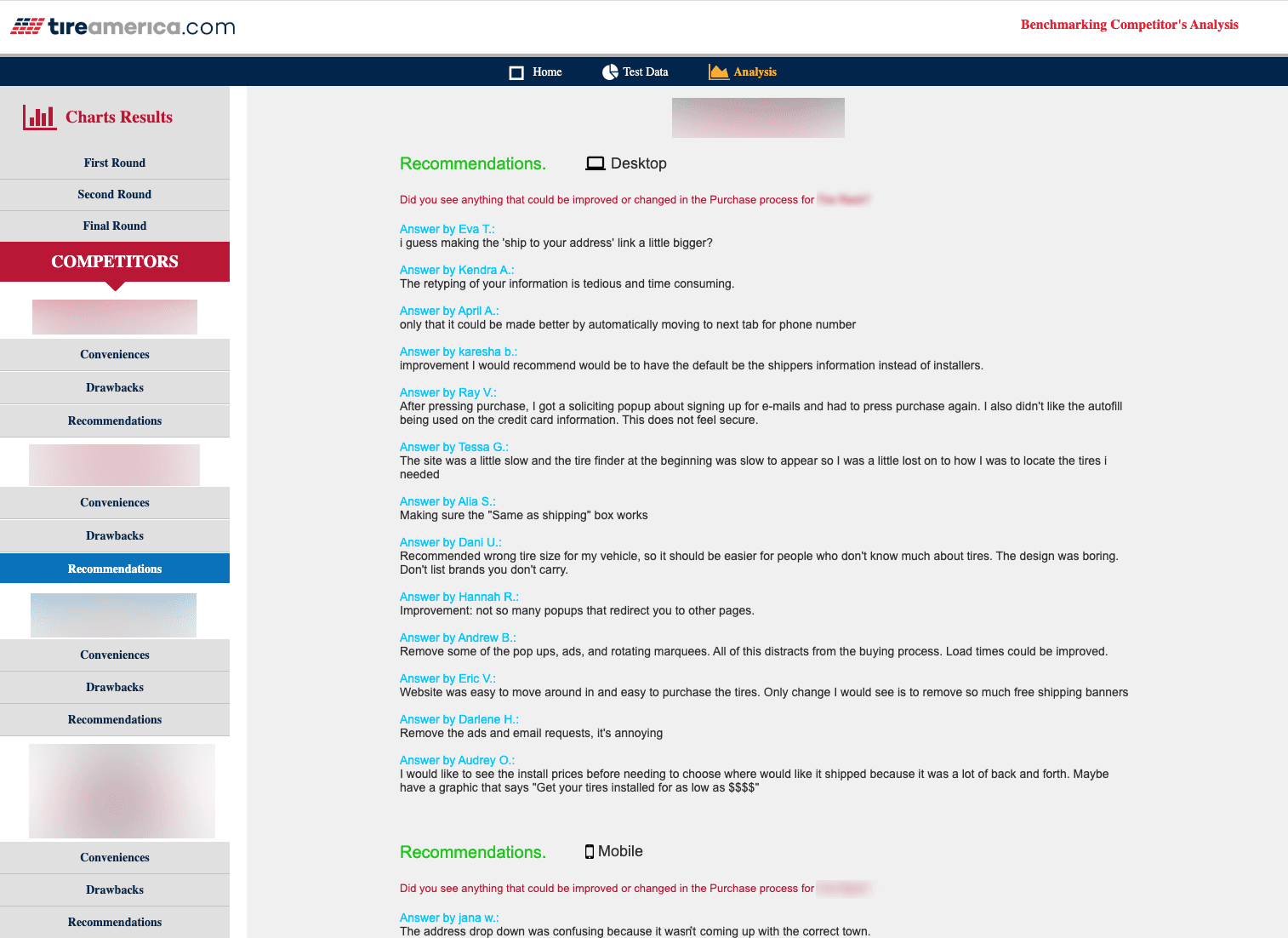
Post-launch, we utilized FullStory session analysis, qualitative customer feedback, and conversion analytics to monitor path health. Iterative usability testing was strictly reserved as a high-precision diagnostic scalpel for identifying risk in highly-sensitive funnels—resulting in deep competitive benchmarking across 120 users.
Behavioral Telemetry
FullStory + Analytics
Real-time funnel leak detection
Benchmarked Participants
120 Users
Industry-wide Usability vs 5 Competitors
Validation Stage: High-Resolution Benchmarking
Quantitative results from the final usability study proving the performance delta achieved through the hi-fi salvage operation.
Competitive benchmarking — confidence and satisfaction metrics
Confidence-to-buy and visual satisfaction metrics breakdown. Highlights areas of competitive differentiation and remaining opportunity gaps on mobile.
Full benchmarking results — Tire America vs 5 competitors across all metrics
Comprehensive benchmarking results dashboard comparing Tire America against 5 competitors across usability, learnability, price satisfaction, visual aesthetics, and confidence to buy.
Architectural Logic: Competitive Benchmarking
- ■Study Scale: 120 remote unmoderated participants (Userlytics) across 6 test rounds.
- ■Performance Delta: Tire America (46.53%) vs Competitor A (27.16%) and Competitor B (26.33%).
- ■Metric Domains: Usability, Learnability, Price Satisfaction, Visual Aesthetics, and Confidence to Buy.
- ■Risk Mitigation: Validated that hi-fidelity rapid prototyping cycles delivered double the industry average usability for desktop shoppers.
UX SYSTEM DESIGN
SYSTEMIC REFINEMENT.
Engineering
Delivered dev-ready annotated wireframes via Axure with interaction specifications, conditional logic documentation, and responsive breakpoint annotations — reducing design-to-dev ambiguity.
Product Management
Partnered on prioritization of checkout friction points using session replay data, aligning UX improvements with quarterly conversion targets and business roadmap.
Research & Analytics
Co-designed the 3-round benchmarking study across 5 competitors, establishing standardized usability, learnability, and confidence metrics via Userlytics.
Final Impact
Outperforming The
Industry Benchmark.
Tire America
Desktop
46.53%
Mobile
43.65%
Competitor A
Desktop
27.16%
Mobile
36.56%
Competitor B
Desktop
26.33%
Mobile
19.78%
Usability scores measured via Userlytics benchmarking study — 120 participants, 6 remote unmoderated tests, metrics include usability, learnability, price satisfaction, visual aesthetics, and confidence to buy.
THE PRINCIPAL VERDICT
A CRO-FOCUSED SALVAGE OPERATION.
Silent Defaults Are Silent Killers
Users don't notice what they didn't choose. The accidental 'Ship to Home' default was invisible in analytics until session replays exposed the pattern. Never assume a pre-selected option is a user decision.
Read Lesson
Dev-Ready Means Annotated, Not Pixel-Perfect
The most impactful handoff artifact wasn't the polished mockup — it was the Axure prototype with interaction specs, conditional logic, and responsive breakpoint annotations that eliminated engineering guesswork.
Read Lesson
Benchmark Against the Market, Not Just Yourself
Internal A/B tests show incremental improvement. Benchmarking against 5 competitors revealed where Tire America was truly differentiated (desktop usability) and where gaps remained (mobile learnability).
Read Lesson
Continue Exploring